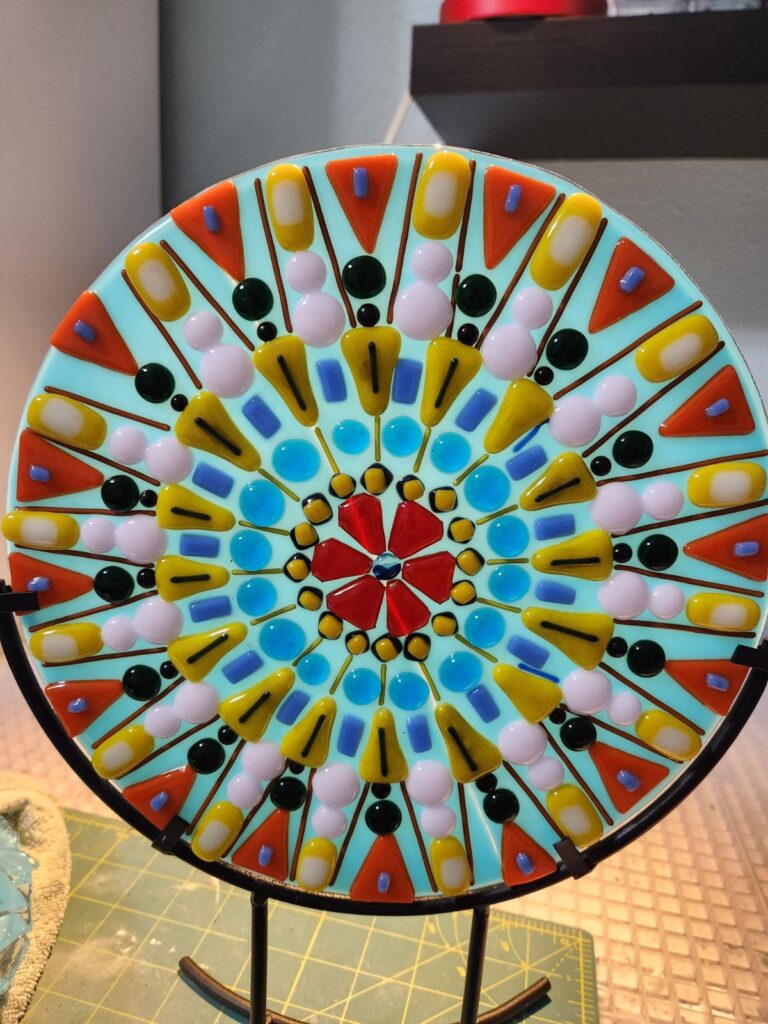
Fused Glass Artistry
Origins
Glass fusing dates back to around 2000 BCE, likely practiced by Egyptians, though some argue Romans developed the earliest techniques. It was the primary method for making small glass objects for about 2,000 years. Glassblowing eventually replaced fusing due to efficiency. The technique saw a revival in the 20th century, especially in the U.S. during the 1960s. Today, it’s both a hobby and a fine-art practice.
Process
Glass fusing is the process of joining pieces or layers of glass by heating them in a kiln until they bond, and used to create Art glass, dishes, tiles, beads and jewelry.
- Artist’s stack or layer thin sheets of glass, often in different colors.
- Kilns heat the glass through controlled ramps and soaks. Temperatures up to 1500 degrees.
- Higher temperatures and longer soaks create smoother, more blended results. Depending on the temperature, the glass may simply tack together or fully merge into a smooth, unified piece. Small pieces can be fired quickly; larger or thicker pieces require longer schedules.
- Cooling must be slow and controlled to prevent breakage—this includes a multi-stage annealing process.
- Pieces then can be used as is, coldworked (to refine the piece), or slumped in 2nd firing into bowl, plate or other forms. ie. Art glass, tiles, beads and jewelry.
- Pieces are unique and often 1 of a kind.